
Central Australian Youth Link-Up Service
Painting by M. Boko, Tangentyere Artists, 2016. Commemorating 10 years of Opal Low Aromatic Fuel in Central Australia.
CAYLUS started as a petrol sniffing prevention project in November 2002 in response to widespread issues in the region at that time. While CAYLUS still remains focussed on preventing sniffing we also work to reduce the impact of other substances like alcohol and gunja on young people in our region.
CAYLUS works to reduce the impact of substance misuse by reducing supply of, harm done by and demand for substances.
Our activities to reduce supply include supporting the use of Low Aromatic Fuel, often known as Opal fuel (see LAF What You Need to Know and facts) and providing advice and support to retailers of high risk products so that they are managed as well as possible.
Activities to reduce the demand involve providing better alternatives to substance misuse to at risk young people. This work includes supporting the development of youth programs, providing youth program infrastructure and resources, working directly with families in remote communities, supporting local Aboriginal youth workers and training and skills development projects.
Our work to reduce the harm caused by substance misuse in our region includes casework, rehab and community education initiatives.
The work of CAYLUS has been independently evaluated a number of times over the years. See our Publications and Archive section below.
CAYLUS youth workers supporting the Central Desert Regional Council’s Laramba youth program
CAYLUS supported initiatives have included developing rehabilitation services, youth programs, a responsible retail of solvents program, infrastructure and maintenance, night patrols, policing initiatives, youth diversion, staff recruitment and youth worker traineeships, mentoring and workshops, computer rooms, internet access and cyber safety, menstrual hygiene management resources, COVID-19 support, local interpreter services, football leagues and carnivals, literature production, and film and radio projects in local languages.
Whilst many supply-reduction measures specifically targeted inhalants, the demand-reduction measures such as development of community-based recreation and youth programs have had a myriad of other health, substance misuse prevention and community safety outcomes.
For an in depth look at the CAYLUS model and approach check out Gillian Shaw’s paper The Provision of Support and Advocacy for Indigenous Young People on a Regional Basis.


Alyawarr kids having fun at Barkly Regional Council Arlparra Youth Program, Utopia.
CAYLUS Governance
CAYLUS is a division of Tangentyere Council and takes direction from a steering committee made up from representatives of the following agencies and communities:
Alice Springs Youth Accommodation and Support Services (ASYASS)
Ngaanyatjarra Pitjantjatjara Yankunytjatjara (NPY) Women's Council
Southern Tanami Kurdiji Indigenous Corporation (STKIC)
CAYLUS Co Managers
Bianca Rayner
CAYLUS Business Manager
bianca@caylus.org.au
Liam Campbell
CAYLUS Operations Manager
liam@caylus.org.au
CAYLUS Service Area
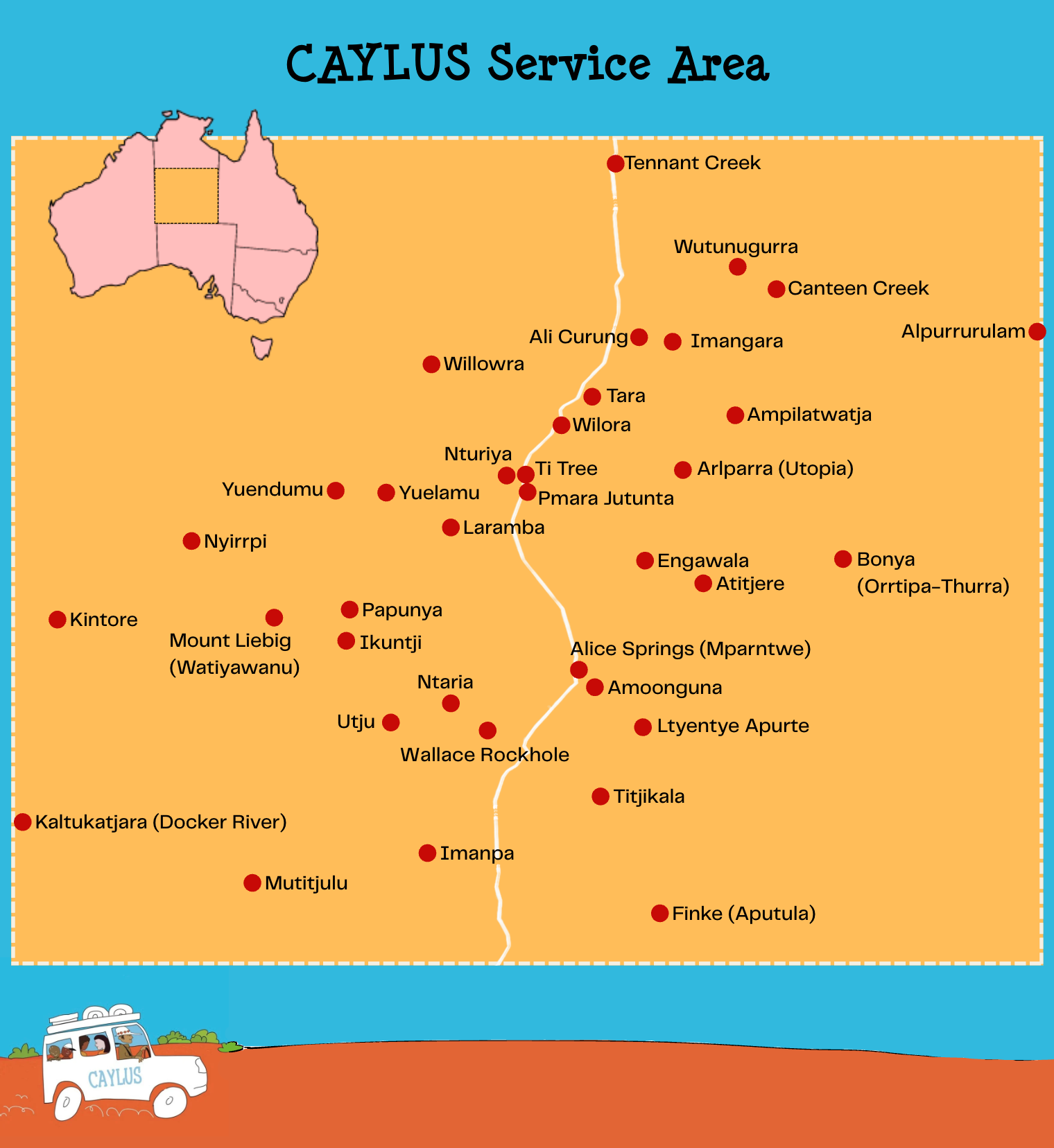
The CAYLUS Service area spans communities across the bottom half of the Northern Territory. CAYLUS only works in communities at the request of local people and agencies, over the 19 years that we have operated we have gradually extended our services to new sites. While CAYLUS primarily services this region, we have occasionally provided assistance to communities further away. In the NT, we have assisted Darwin, East Arnhem, Tennant Creek and Katherine, and in WA, Kiwirrkurra, Balgo and Jigalong.
CAYLUS History
CAYLUS commenced operation during a period when petrol sniffing was an enormous issue across much of Central Australia. At this time availability of reliable youth programs in our service region was also limited. CAYLUS staff initially promoted use of aviation gas as an alternative fuel that was less intoxicating if sniffed, along with developing youth programs and promoting the use of the Misuse of Drugs Act (NT) to prevent deliberate dealing and supply of fuel and other substances to sniff.
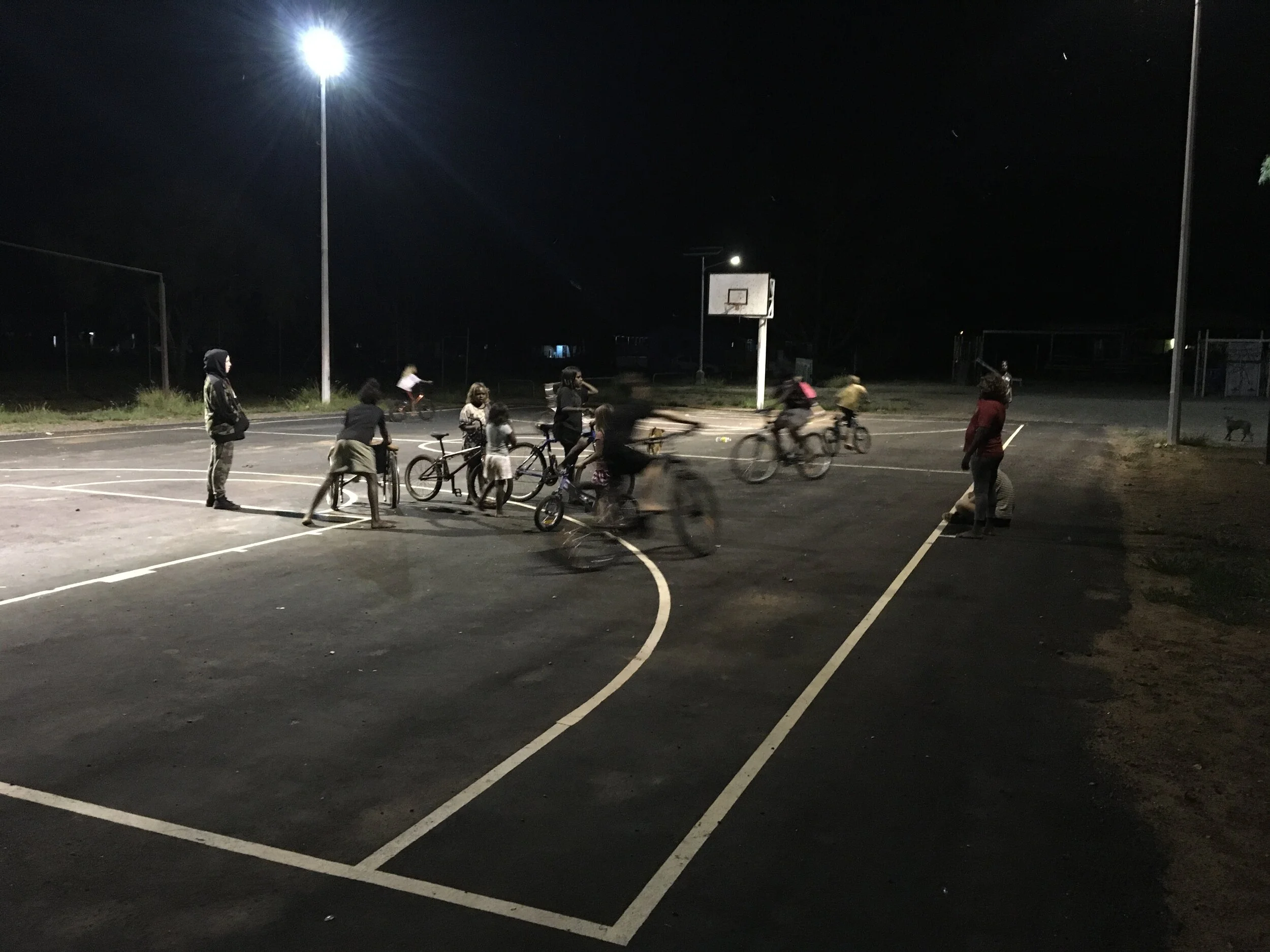
Youth programs across the region run regular day and nighttime activities
Atitjere Youth Program, Central Desert Regional Council
CAYLUS staff worked closely with families to facilitate access to rehabilitation programs and worked with these services to varying degrees to help develop their programs and services. This approach builta more systematic response to sniffing and helped reduce the damage that was being done, it didn't however greatly reduce prevalence of sniffing in many communities as standard unleaded was still readily available.
As CAYLUS has supported remote communities efforts to make high-risk substances harder to access for sniffing, we have also needed to work with retailers in the regional centre Alice Springs to ensure that such products are well managed there also. The CAYLUS Volatile Substances Supply Reduction worker works supporting retailers in Alice Springs to manage products well, as a part of this work we developed a range of resources for retailers but importantly have been available and responsive to retailers needs including providing practical assistance where we can.
In 2004/05 CAYLUS staff worked with other stakeholders to advocate to the NT government for a range of measures including better data collection, better policing around petrol sniffing and better rehabilitation options. This resulted in the introduction of the NT Volatile Substance Abuse Prevention Act 2005 and a complementary investment in support programs by the NT government. One of the most useful outcomes of this legislation has been that it gives communities the ability to make laws around the management of volatile substances. Some communities used these powers to make possession of standard unleaded petrol illegal altogether within their bounds, thereby making petrol dealing far more difficult.
With the advent of Opal/ Low Aromatic Fuel in 2005, it became feasible for the first time to implement a non-intoxicating fuel across the region. CAYLUS staff worked with communities promotingand supporting the use of the fuel. As a part of the Opal Alliance we also advocated for a change in Commonwealth government policy, first to allow roadhouses to use the fuel and eventually to a region wide rollout in Central Australia. For a full account of this process see CAYLUS and the Opal Alliance.
Lance McDonald, indigenous resident of Papunya, Central Australia, talks about how Opal Fuel prevented petrol-sniffing in his community.
The regional roll out of Opal has been a major success, the 2009 Evaluation of the Impact of Opal Fuel found that across all sites there has been a 70% reduction in prevalence of petrol sniffing and that in Central Australia this has been in excess of 90%. It has been very gratifying to be able to see the change on the ground in communities as a result. See the video from Papunya below to hear an account from that community. Our advocacy work in this area continues though, as a small number of retail outlets continue to refuse to stock the fuel despite the likely benefit to nearby communities. CAYLUS staff continue to work toward budiling availability of good quality youth programs for youth and families in all communities in order to engage youth in positive activities and programs. There is currently no Government commitment that ensures such services are available to all remote NT Youth. For further information on the case of Youth Services see the 2011 CAYLUS discussion paper Youth Development In Central Australia Beyond 2012.
For further information on the case of Youth Services see the 2011 CAYLUS discussion paper Youth Development In Central Australia Beyond 2012.
CAYLUS operates with funding from the Australian Government, Northern Territory Government, the Warlpiri Education and Training Trust and contributions from a range of institutional and private donors.
Publications and archive
-
-
• Maggie Brady - Parental Responsibility and Sniffing (30K)
• Pauline Fietz - Childhood Paper (417K)
• The Brain Story (powerpoint file) (817K)
• The Mt Theo Story (1999) (809K)
• The Willowra Story (89K)
• The model and achievements of the Central Australian Youth Link Up Service - Gillian Shaw (718K)
• Youth Development in Central Australia: Beyond 2012 (981K)
• d'Abbs - Brady - Government Policy Development (89K)
• d'Abbs - Maclean Report - Review of Interventions (352K)
• Centre for Remote Health - Youth Programs in Central Australian Aboriginal Communities (722KB)
-
• CAYLUS 'Link Up' Newsletter 2022 (5MB)
• CAYLUS 'Link Up' Newsletter 2010 (5MB)
• CAYLUS 'Link Up' Newsletter 2009 (2.9MB)
• CAYLUS 'Link Up' Newsletter 2007 (2MB)
• CAYLUS 'Link Up' Newsletter 2006 (3.6MB)
• CAYLUS 'Link Up' Newsletter 2004 (1.3MB)
• CAYLUS 'Link Up' Newsletter 2003 (3.7MB)
-
• 2021 CAYLUS Submission to the Regional Telecommunicaions Review (126K)
• 2021 Submission to Drivers License Inquiry (2MB)
• 2021 Submission to Senate Committee FASD (10.9MB)
• 2020 Coronial Submission (2.4M)
• 2019 Submission to the Productivity Commission Inquiry into Expenditure on Children in the Northern Territory (521K)
• 2018 CAYLUS Submission to the Regional Telecommunicaions Review (1.6M)
•2015 Submission to the Senate Inquiry into the Commonwealth Indigenous Advancement Strategy Tendering Processes (221KB)
• 2014 Submission to the Inquiry into the Harmful Use of Alcohol in Aboriginal and Torres Strait Islander Communities (72.1M)
• 2005 CAYLUS Coronial Submission (789K)
• 2005 Coronial Inquest Findings (5MB)
• CAYLUS Submission to the 2005-2006 Senate Inquiry into Petrol Sniffing(580k)
• CAYLUS Submission to the 2011 Select Committee of Inquiry into Youth Suicides in the NT (167K)
• 2011 CAYLUS submission to the WA Coronial Inquiry into deaths at Balgo (1.4MB)
• 2011 Balgo Coronial Inquiry Findings (418K)
• 2012 CAYLUS Submission to the Senate Inquiry into the Low Aromatic Fuel Bill (1.6MB)
• 2012 Report from Senate Inquiry into the Low Aromatic Fuel Bill2012 (462K)
-
• FACS Child Welfare Protocol (word doc) (52K)
• FACS Notification Form (word doc) (64K)
• Baseline model and resources for a basic youth program (124K)
• Volatile Substance Abuse Prevention Bill (500K)
• Briefing paper on Papunya Computer Room (155K)
• Volatile Substance Misuse Prevention Initiatives - poster (694K)
• VSAP ACT Factsheet (100k)
• Papunya Palya Lingku Video (link)
Methamphetamine Presentations from the Alice Springs Forum, November 4, 2015
• Ross Bell - Never Let A Crisis Go To Waste.pptx (1.6MB)
• Tracey Brand- A Central Australian Aboriginal Community Perspective.pptx (6.5MB)
• John Boffa - A Comprehensive Primary Health Care Approach To Ice, Alcohol and Other Drugs.pptx (8.2MB)
• Ann Roche - Workplace as a Methamphetamine Prevention and Intervention Site.pptx (2.9MB)
Ann Roche - Methamphetamine Use in Australia 2015.pptx (4.8MB)
• Nicole Lee- Breaking the Ice Methamphetamine Use in Australia and Effective Responses.pdf (11.6MB)
The following screencasts were presented at the US National Institute on Drug Abuse International Forum on Volatile Substance Abuse in June 2009.
-
Youth Programs
Barkly Youth (Barkly Regional Council)
BushMob | for young people who are at risk of being disengaged
NPY Youth (NPY Women’s Council)
Mac Youth (MacDonnell Regional Council)
Remote Media Organisations
Health Organisations
NACCHO (National Aboriginal Community Controlled Health Service Organisation)
Ngaanyatjarra, Pitjantjatjara and Yankunytjatjara Women's Council
DASA - Drug and Alcohol Services Alice Springs
Council for Aboriginal Alcohol Program Services Inc.
Regional Councils in the CAYLUS region
-